
The Hidden Cost of Paper Timesheets in Construction
Paper timesheets cost construction companies far more than most owners realize. From payroll errors to bad job costing, here's what they're really costing you.
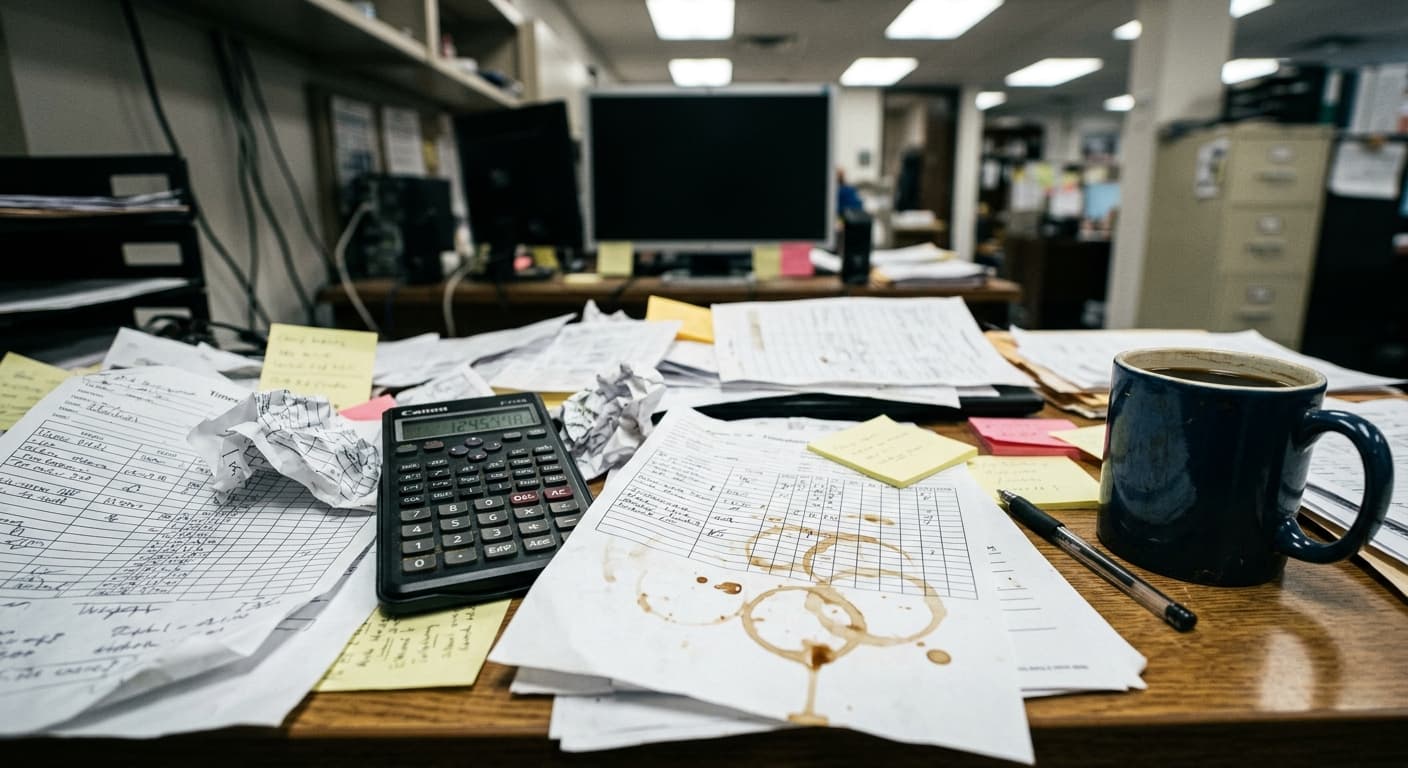
It's Monday morning. You need to run payroll by Wednesday. And right now, you're staring at a stack of timesheets that are late, incomplete, or both.
One foreman texted his crew's hours in a group chat. Another one scribbled them on the back of a delivery receipt. Two guys didn't submit anything at all, and you're playing phone tag trying to track them down. The ones you do have? Half the entries say 7:00 to 3:30, which might be accurate or might be what the worker remembers from a week ago.
If you run a construction company with field crews, this is your life. And it's costing you a lot more than the price of a stack of paper.
The admin hours you're burning every week
Start with the most obvious cost: the time your office staff spends on timesheets.
Collecting, chasing, deciphering, entering, and reconciling paper timesheets is a job in itself. For a company with 30 to 60 field workers, it's common for an admin to spend 8 to 15 hours per pay period just getting timesheet data into a usable state. That's before they touch payroll.
We've seen it get worse. One construction company we work with had their admin spending two full days every pay period just pulling equipment hours out of the notes field on time entries. Workers were typing things like "excavator 3hrs" and "skid steer 2.5h" in free text, and someone had to read every single entry and manually extract the data. Sixty-plus employees, every pay period.
That's not an admin doing admin work. That's a human being used as a data parser. And the salary you're paying for those hours is real money going to a problem that shouldn't exist.
The payroll errors you can't see
Paper timesheets are self-reported, unverified, and often filled out days after the work happened. That creates a gap between what actually happened and what you're paying for.
Workers who forget to clock in fill out their timesheets from memory at the end of the week. Everything becomes a clean 8-to-5, whether the actual shift started at 7:15 or 8:45. Rounding up by 15 to 30 minutes per day might not seem like much. Across a 40-person crew over a year, that's thousands of hours you're paying for that nobody worked.
Then there's buddy punching. One worker clocks in for a friend who's running late. Or a worker clocks in at one location and drives to another without anyone knowing. With paper timesheets, there's no way to verify who was where and when. You're taking everyone's word for it, and you're paying based on trust with no way to audit.
None of this means your people are dishonest. It means the system makes it easy to be inaccurate, and there's zero accountability built in. That's a system problem, not a people problem.
The job costing data that's basically fiction
Here's where paper timesheets get really expensive: they wreck your ability to know which projects are profitable.
Accurate job costing depends on knowing how many labor hours went to each project, each phase, and each cost code. Paper timesheets rarely capture that level of detail. When they do, the data is unreliable because it was written down from memory.
If a worker splits their day between two job sites, which one gets the hours? On a paper timesheet, the answer is usually "whichever site they remember" or "the one they write down first." The split is a guess.
Equipment hours are even worse. Most paper systems don't track equipment usage at all, or they bury it in a notes field where someone has to manually extract it. The result is that your equipment costs per project are either missing or wrong.
This means you're bidding future jobs based on past data that was never accurate in the first place. You might be underbidding because you didn't capture the true labor cost. Or you might be overbidding and losing work you should have won. Either way, you're flying blind.
The disputes that erode trust
Payday should be simple. The worker did the hours, the company pays for the hours, everyone moves on. Paper timesheets make that harder than it needs to be.
When there's no shared, verifiable record of when someone clocked in and out, disputes are inevitable. A worker says they worked 42 hours. The office has them down for 38. Who's right? Without GPS-verified timestamps, there's no way to settle it. Someone has to give, and someone walks away frustrated.
These disputes might seem small individually. Over time, they chip away at the relationship between field crews and the office. Workers start to feel like the company is shaving hours. The office starts to feel like workers are inflating them. Nobody trusts the data because the data was never trustworthy.
What actually fixes this
The fix isn't a better form or a fancier spreadsheet. It's capturing time data at the source, when and where the work happens, so nobody has to reconstruct it later.
That means workers clock in and out from their phones, right on the job site. GPS verification confirms they were actually there. The timestamp is real, not remembered. If they split their day across two cost codes or two job sites, they log each segment as it happens.
Equipment hours get logged separately, tagged to the job site, with the equipment selected from a list instead of typed into a notes field. No extraction required.
The data flows to the office in real time. Admins see clean, organized entries that are ready for approval and payroll. No chasing, no deciphering, no two-day data entry marathons.
This is what we built WorkxPro to do. Not as a surveillance tool or a complicated enterprise system. As a practical tool that construction crews actually use in the field, and that gives the back office their week back. (We wrote about how this started if you're curious.)
Stop paying for the problem
Every week you spend chasing paper timesheets is a week you're paying admin hours for data entry, overpaying for hours that weren't worked, flying blind on job profitability, and creating friction between your crews and your office.
The real cost isn't just the paper. It's the decisions you can't make because the data isn't there, and the money you're losing because the data is wrong.
14-day free trial. No credit card required. See what your timesheet process looks like when the data comes to you, verified and organized, instead of the other way around.